

By the time many people begin wondering whether they should see a doctor or a dentist, they’ve already spent weeks or months trying to figure out whether their symptoms could be related to TMJ disorder. Once the jaw starts looking like a possible piece of the puzzle, knowing where to turn next isn’t always straightforward.
Part of the uncertainty comes from the fact that TMJ disorder is evaluated by professionals in more than one field. Depending on who you ask, you may hear different recommendations, each shaped by that provider’s area of expertise. The best starting point depends less on the diagnosis itself and more on the individual sitting in the chair. The same label can describe very different conditions, which is why effective treatment begins with understanding your specific circumstances.
Many of the patients who visit us from Tanglewood, the Galleria, Memorial, Uptown, River Oaks, and surrounding Houston neighborhoods have already seen at least one healthcare provider before scheduling a TMJ evaluation. They’re often less concerned about whether the next appointment is with a doctor or a dentist than whether it will finally bring them closer to an answer.
Why It’s So Hard to Know Where to Start
TMJ disorder occupies an unusual place in healthcare. It isn’t purely a dental problem, but it isn’t purely a medical one either. Because the jaw influences everything from chewing and bite function to muscles, joints, and surrounding structures, several different types of providers may play a role in diagnosis or treatment. That overlap leaves many patients asking the same question: Who am I actually supposed to see?
There isn’t a universal answer because the right starting point depends on the symptoms and the provider’s experience. A physician may be focused on ruling out neurological or medical conditions. An ENT may evaluate the ears. A physical therapist may examine movement. A dentist with advanced TMJ training is often evaluating how the joints, muscles, bite, and teeth work together. In many cases, that broader evaluation can help determine whether the jaw is truly part of the problem and what the most appropriate next step should be.
Why a Dentist Can Be a Good Starting Point
If your symptoms seem to involve the way your jaw feels or functions, a dentist with extensive experience evaluating TMJ disorders can often be a practical place to start. During a single visit, they can assess the jaw joints, chewing muscles, bite, tooth wear, jaw movement, and other signs that may point toward how the system is functioning. Just as importantly, they can help determine when the jaw may not be the primary source of the problem.
That doesn’t mean every case begins and ends at the dental office. Some patients benefit from working alongside physicians, physical therapists, sleep specialists, or other healthcare providers, depending on what’s contributing to their symptoms. When another provider’s expertise can improve the outcome, Dr. Kheir sees collaboration as an important part of good patient care. The goal isn’t to keep every patient within one specialty. It’s to understand where the symptoms are coming from and make sure the right people are involved.
Experience Matters More Than the Title
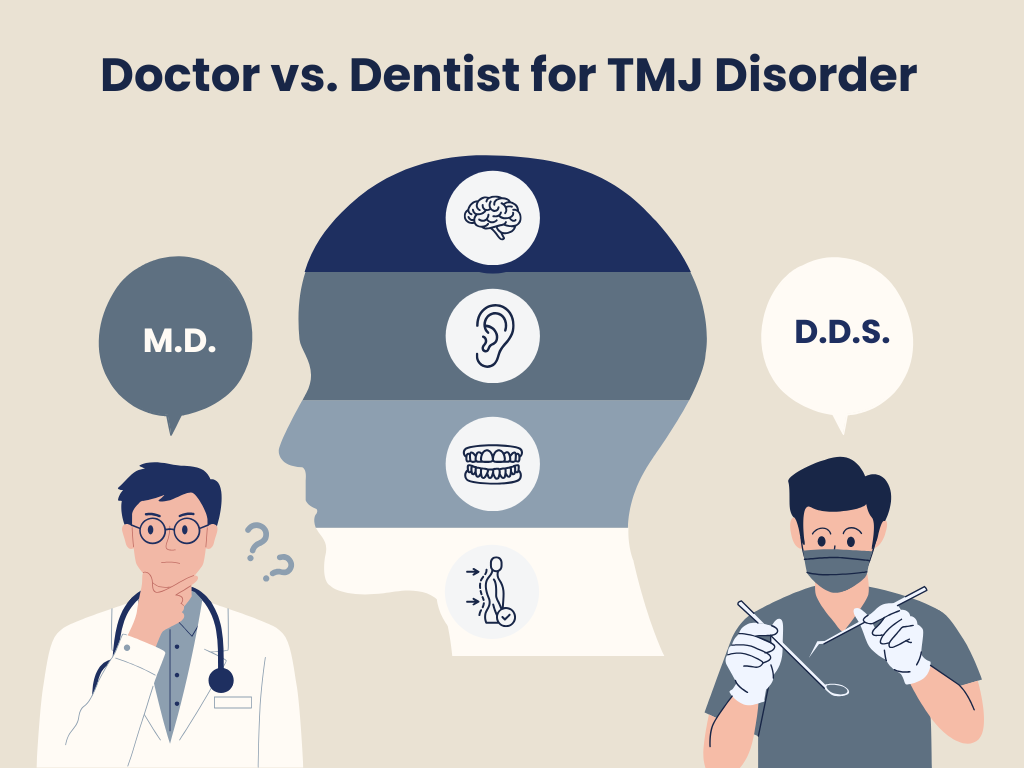
Every healthcare provider brings a different perspective to TMD, but experience shapes what they notice. After evaluating these conditions for decades, Dr. Kheir has learned that patients with very different complaints can sometimes be dealing with the same underlying issue, while patients who describe nearly identical symptoms may need completely different treatment. That perspective comes from seeing hundreds of cases over time, not from a job title alone.
Many of the patients he sees don’t arrive convinced they have TMJ disorder. They come in because they’re tired of living with symptoms that haven’t been fully explained, or because previous treatment never addressed the bigger picture. If your experience sounds similar, an evaluation with someone who routinely works with the TMJ may be a practical place to start.
Experience matters just as much as professional credentials. While every dentist learns about the jaw during training, not every dentist regularly diagnoses and treats TMJ disorders. Dr. Kheir has spent years evaluating how the jaw, muscles, bite, and surrounding structures work together. This gives many patients to leave their first visit with something they’ve often been searching for all along: a clearer understanding of what’s actually happening and what the next steps should be.
Did You Know?
“Many patients don’t come to our office looking for TMJ treatment. They come in for routine dental care and casually mention headaches, neck tension, ear fullness, or facial pain, never realizing those symptoms could be related to their jaw.”
What Actually Happens During a TMJ Evaluation
Many people are surprised by how straightforward a TMJ evaluation can be. While imaging has an important role in some cases, much of the information comes from understanding your symptoms, examining how your jaw functions, and looking at how the entire system works together.
Every evaluation starts with a conversation. Dr. Kheir wants to understand when your symptoms began, how they’ve changed over time, what seems to make them better or worse, and how they’re affecting your daily life. Previous injuries, dental work, sleep habits, clenching, grinding, and treatments you’ve already tried can all provide valuable clues.
Next comes the physical examination. Dr. Kheir evaluates how your jaw opens and closes, how the joints move, whether the muscles are tender, and how your teeth come together when you bite. Looking at these findings together often reveals patterns that aren’t obvious when each symptom is viewed on its own.
Not every patient needs a scan. When additional imaging is likely to change the diagnosis or treatment plan, it can provide valuable information about the joints and surrounding structures. When the examination already provides the answers needed, more testing isn’t always necessary.
One of the most important outcomes of the evaluation is understanding whether your symptoms are actually related to TMJ. Sometimes they are. Sometimes another condition deserves further investigation instead. The goal isn’t to confirm TMJ at all costs. It’s to identify the most likely source of your symptoms and help you move forward with confidence.
One Thing That Surprises Most Patients
Patients often assume that a condition as complicated as TMJ disorder must require an equally complicated solution. Dr. Kheir recalls a woman who laughed when she first saw the oral appliance he recommended. She expected something much more elaborate after everything she’d already tried.
Not long afterward, she was treating that same appliance like one of her most valuable possessions because it had become part of getting through her day comfortably. Experiences like that have reinforced a philosophy Dr. Kheir has carried throughout his career: the success of a treatment depends far less on how complicated it is, than how well it’s matched to the patient’s circumstances.
Dr. Kheir’s Approach
Choosing between a doctor and a dentist doesn’t have to feel like a guessing game. If your symptoms suggest the jaw may be involved, the most valuable first step is often finding someone with the experience to evaluate the entire system, explain what’s happening in plain language, and recommend the least invasive path forward.
That’s the philosophy Dr. Kheir has built his practice around. Every patient deserves to understand why they’re experiencing the symptoms they are, what role the jaw may be playing, and whether treatment is likely to help. Sometimes the evaluation confirms TMJ disorder. Sometimes it points in another direction. Either outcome replaces uncertainty with a clearer plan, and for many patients, that’s the answer they’ve been looking for all along.



UNDERSTAND TMJ Disorder treatment in Houston
TMJD Treatment Starts With Understanding the Cause
With more than 30 years of experience, Dr. Mohamad Kheir has spent his career solving problems that don’t always have simple answers. His background in reconstructive, cosmetic, and TMJ dentistry allows him to see how the teeth, bite, muscles, and jaw work together as one system. That perspective helps guide treatment that’s designed not only to relieve today’s symptoms, but to support healthier function for years to come.
Because treatment should improve the whole system, not just one symptom.
Explore TMJ Disorder Topics
-

Types of TMJ Disorders: Why Two People With “TMJ” Can Need Completely Different Treatment
Read more: Types of TMJ Disorders: Why Two People With “TMJ” Can Need Completely Different Treatment -

How Do I Know It’s TMJ Disorder? Signs Your Jaw May Be the Source of Your Symptoms
Read more: How Do I Know It’s TMJ Disorder? Signs Your Jaw May Be the Source of Your Symptoms -
How Dentists Treat TMJ Disorder: From Diagnosis to Treatment
Read more: How Dentists Treat TMJ Disorder: From Diagnosis to Treatment
